The Parable of the Hidden Treasure

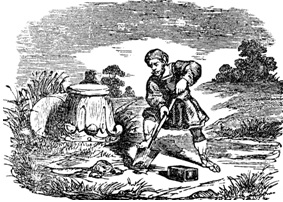
Again, the kingdom of heaven is like unto treasure hid in a field; the which when a man has found, he hide, and for joy thereof go and sell all that he had, and buy that field. Mat. 13:44 KJV

The treasure illustrates Israel in the kingdom of Heaven, partaking in the kingdom or realm of profession in this age. She, Israel, is like a treasure Ps. 135:4; Ex. 19:5; Mal. 3:17 hidden or lying in the world in the sense that Israel’s testimony as witnesses for God is veiled, Rom. 9:1–11:29  lying dormant and failing to fulfill her calling. The field is the world as in all preceding parables. Mt. 13:38 The treasure was not in the world when the devil took possession of it. When Christ came to seek the treasure it was hidden in the world. The man is Christ Mt. 13:34,37 seeking the treasure. Jn. 1:11-12; Mt. 23:37-39 and joyfully gives His all to buy the field Jn. 11:51; Rom. 8:17-25; 1 Pet. 1:18-19; 2 Pet. 2:1 to get the treasure and all else in the field. Php. 2:5-8; 2Cor. 8:9; Tit. 2:14; Heb. 12:1-2 The treasure, though found, Mt. 10:6; 15:24; 23:37-39; Acts 13:46 remains hidden in the world until Christ comes to take possession of it at His second coming. Rom. 11:25-29; Lk. 21:24; Lk. 1:32-33; Isa. 9:6-7 Then the treasure, as well as the field, will be His. Eph. 1:14; Rom. 11:25-28; Lk. 21:24; Rev. 19-20; Rom. 8:17-25 His joy in giving all for the field is experienced in view of the glorious restoration of all things and the treasure, Israel, exalted and made a blessing to all nations as originally planned. Heb. 12:2; Rom. 11; Lk. 1:32-35; Isa. 9:6-7

The Parable of the Leaven

Another parable spoke He unto them; The kingdom of heaven is like unto leaven, which a woman took, and hid in three measures of meal, till the whole was leavened. Mat. 13:33 KJV

The kingdom of Heaven here is “like” leaven (sour dough) that is always used in a bad sense in Scripture, as meal is in a good sense. Therefore, the common interpretation of leaven converting the world is the exact opposite of the true interpretation of the leaven corrupting the meal. Note the use of leaven in Scripture:

In the Old Testament leaven is used to portray the evil nature of the sinner: Exodus 12:8, 15-20; 34:25; Levitikus 2:11; 6:17; 10:12 These last three passages refer to leaven being forbidden in certain sacrifices. Only in one sacrifice was it used in Levitikus 7:12-13 and here it signifies that though the believer has made peace with God through the work of another (Christ), there are still human traits and selfishness in him which must be continually purged by growth in grace.

In the New Testament leaven is used in four ways: first, the leaven of the Pharisees which was external religion, legalism, and hypocrisy; Mt. 23:14-28; Lk. 12:1 second, the leaven of the Sadducees, which was skepticism as to the supernatural and the teachings of the Scriptures on resurrection, angels, and spirits; Mt. 22:23-39; Acts 23:8 third, the leaven of the Harridans, which was materialism, a mixture of religion and worldliness, a political religion; Mk. 8:15 fourth, the leaven of both Pharisees and Sadducees as to their evil doctrines and practices. Mt. 16:11-12; 23:14, 16, 23-28

This illustrates how the kingdom of heaven teachings and the program of God in this age would become corrupted by false doctrines and unscriptural programs until the whole is corrupted. Lk. 18:8; 1Tim. 4:1-8; 2Tim. 3:5; 4:3-4; 2Pet. 3:3-4  A woman is a common symbol of evil in the moral or religious sphere and when used figuratively in an evil sense ‘she’ represents wickedness, fallacy, uncleanness, and unfaithfulness, Lam. 1:17 harlotry, Ezek. 16:15,22,26,28-59; 23:1-49; 36:17; Hos. 1:2; 2:2-17; 3:1; Rev. 17 wickedness, Zech. 5:5-11; Rev. 17:5 and false religion. Rev. 17 Thus, in a bad ethical sense a woman always symbolizes something wrong or out of place religiously.  Zech. 5:7-8; Rev. 2:20; 17:1-18  When used in a good sense women represent Israel, cp Gen. 37:9-10 with Rev. 12; Ezek. 16 the two covenants, Gal. 4:21-31 and righteousness and purity. 2Cor. 11:2; Rev. 19:7-8 A meal symbolizes the Word of God. Mt. 4:4; Jn. 6:47-63 and the three hidden measures of the meal illustrates all false teachings, religious programs, and professed Christian lives that seek to hide behind the Word of God (Christ as the Bread of Life and the Word of God Mt. 4:4; Jn. 6:47-63; Jn. 1:1).

The parable illustrates how the kingdom of Heaven would become like leaven, which a woman uses to corrupt Christ and His teachings. Both Christ and the Word of God are being corrupted today by the false church and its teachings. These teachers dominate the realm of profession and use it to deceive people by exalting their own words above the Word of God and their own leaders above Christ; by making the people feel that their church is infallible and that obedience to it and its dogmas is better than obedience to civil governments and by many comparable doctrines contrary to the Bible, thus corrupting the truth through the realm of profession.

Your glorying is not good. Know ye not that a little leaven leaven the whole lump? Purge out therefore the old leaven, that ye may be a new lump, as ye are unleavened. For even Christ our passover is sacrificed for us: Therefore let us keep the feast, not with old leaven, neither with the leaven of malice and wickedness; but with the unleavened bread of sincerity and truth. 1Cor. 5:6-8 KJV

The Parable of the Mustard Seed

Another parable put he forth unto them, saying, The kingdom of heaven is like to a grain of mustard seed, which a man took, and sowed in his field: Which indeed is the least of all seeds: but when it is grown, it is the greatest among herbs, and become a tree, so that the birds of the air come and lodge in the branches thereof.  Mat. 13:31-32 KJV

The kingdom of Heaven is compared to a mustard seed, that has a small beginning and grows rapidly to an abnormal size so that it becomes a tree sheltering things that it was not intended to shelter. The mustard seed is mentioned in Mt. 13:31; 17:20; Mk. 4:31; Lk. 13:19; 17:6. In all these passages the minuteness of the seed is referred to, while in the first three the large size of the herb growing from it is mentioned. Several varieties of mustard have notably small seeds and under favorable conditions grow in a few months into tall herbs – ten to twelve feet high. The rapid growth is always a striking fact. Among the rabbis a grain of mustard was a common expression for anything minute, a meaning which explains our Lord’s phrase, “faith as a grain of mustard seed”. Mt. 17:20; Lk. 17:6

The “birds” are the same that devoured the seeds by the wayside in the parable of the sower. They are demon powers headed by the devil. This parable illustrates rapid and abnormal growth of the kingdom of Heaven from an insignificant beginning to a great place in the Earth, from being poor, little known, and separate from the world to being a great worldly institution, and the habitation of wicked men and demon powers. Mt. 13:4, 19, 32; Rev. 17:1-18; 18:2 This parable emphasizes the truth of the parable of the tares and wheat – that God’s purpose was to have only wheat in the field and that the kingdom of Heaven should be made up of only good people, but an enemy sowed tares and changed the true aspect of the kingdom to an abnormal condition of a mixture of good and bad.

The Parable of Weeds

Another parable put he forth unto them, saying, The kingdom of heaven is likened unto a man which sowed good seed in his field: But while men slept, his enemy came and sowed tares among the wheat, and went his way. But when the blade was sprung up, and brought forth fruit, then appeared the tares also. Mat. 13:24-26 KJV

The sower illustrates the Son of Man (Jesus) Mt. 13:37 and the “good seed” illustrates the true children of the kingdom of Heaven. The field illustrates the world of men and the tares illustrate the professed children of the kingdom who are, in reality, the sons of the devil, who sowed them among the wheat. Mt. 13:25, 38-39 The wheat being in the ground first shows God’s plan concerning the kingdom, that only good shall be in it and that every one who professes to be a child of God should really be one. An enemy – the devil Mt. 13:25,28,39; Lk. 10:19; Acts 13:10 – sowed tares among the wheat, causing a mixture of good and bad in the same field. Thus, the kingdom of Heaven now takes on a new aspect and should rightly be understood as “the sphere of profession, “Christendom,” or “the kingdom of Heaven in mystery.”

It was common in the East for enemies to sow tares and other poisonous seeds in the fields of those they wished to hurt. In India various weeds are sown that take years to get rid of.  The word “tares” – the Greek, zizania, occurs only in Matthew 13:25, 36 is not the same as the darnel of the naturalists, but zewan, as known in Palestine today. While growing it looks like wheat, but when full grown the ears are long and the grain is black. Each grain of the zewan must be removed before grinding the wheat, or the bread is bitter and poisonous. Tares show their true color as they ripen. Verse 26 shows that the tares could not be detected until the fruit began to appear. Mt. 7:15-20

He said unto them, An enemy hath done this. The servants said unto him, Wilt thou then that we go and gather them up? But he said, Nay; lest while ye gather up the tares, ye root up also the wheat with them. Let both grow together until the harvest: and in the time of harvest I will say to the reapers, Gather ye together first the tares, and bind them in bundles to burn them: but gather the wheat into my barn. Mat. 13:27-30 KJV

The tares and the wheat both grow side by side in the same field, which is the will of the householder, until the harvest. Mt. 13:37-40 Both saved and unsaved who profess to be children of the kingdom will mingle together in this world until the end of the age. The harvest illustrates the separation of the wicked among the just at the end of this age when the Messiah comes to reign. Mt. 13:39-43; 25:31-46; 1 Thess. 5:1-11; 2 Thess. 1:7-10; Jude 14; Zech. 14:1-21   The reapers illustrate angels who will separate the wicked from the good when Christ comes. Mt. 13:39-43; 24:31, 51; 25:31-46; 2 Thess. 1:7-10

As therefore the tares are gathered and burned in the fire; so shall it be in the end of this world. The Son of man shall send forth his angels, and they shall gather out of his kingdom all things that offend, and them which do iniquity;  And shall cast them into a furnace of fire: there shall be wailing and gnashing of teeth. Then shall the righteous shine forth as the sun in the kingdom of their Father. Who hath ears to hear, let him hear. Mat. 13:40-43 KJV

The expression of “the end of the world” means “the end of the age.” At this time the kingdom of Heaven ceases to be the sphere of profession and becomes the literal kingdom of Heaven, or the reign of the Messiah over all the kingdoms of this world. Rev. 11:15; Dan. 7:13-14, 18

When the tares are gathered and burned in the fire, refers to the time when the judgment of the nations Mt. 25:31-46; Dan. 7:9 will be executed. The tares will be burned in the same sense the branches of Christ will be if they do not abide in Him. Mt. 8:12; 13:40-43,49-50; 24:31; 25:41,46; Jn. 15:6

The furnace of fire where there shall be wailing and gnashing of teeth is another description of eternal hell, not the grave. Mt. 13:42,50; Rev. 9:2 Wailing, Mt. 13:50 weeping Mt. 8:12; 22:13; 24:51; 25:30; Lk. 13:28 and the gnashing of teeth, picture bitter remorse and pain. The righteous will take over the kingdoms of this world forever Rev. 1:5-7; 5:10; 11:15; 20:4-6; 22:4-5; Mt. 25:31-46; Zech. 14 and they will be luminous like the sun Mt. 19:28; 25:31-46; Rev. 5:10; 20:1-10 and inherit all things. Mt. 5:5; 25:35; Lk. 12:32; Rom. 8:17; Dan. 7:18,22,27; Rev. 21:7

I choose to hear what the Word of God says and will live in obedience so that I can shine forth as the sun in the kingdom of my Heavenly Father! Amen


The Parable of the Sower

And he spoke many things unto them in parables, saying, Behold, a sower went forth to sow… Mat 13:3 KJV

This parable pictures the classes of hearers in the kingdom of Heaven – the whole course of this age of grace, portraying the reception of the Word of God in different hearts and the results that follow.  The sower illustrates the Son of Man (Christ) and the seed illustrates the Word of the kingdom.

And when he sowed, some seeds fell by the way side, and the fowls came and devoured them up … When any one hear the word of the kingdom, and understand it not, then come the wicked one, and catch away that which was sown in his heart. This is he which received seed by the way side. Mat 13:4,19 KJV

The seed sown on wayside ground, being eaten by the fowls illustrates a class of people who hear the Word of the kingdom and refuse to obey it because of indifference and lack of understanding. The devil immediately catches away the Word sown in the heart lest it should germinate and bring forth fruit. 2 Cor. 4:4

Some fell upon stony places, where they had not much earth: and forthwith they sprung up, because they had no deepness of earth: And when the sun was up, they were scorched; and because they had no root, they withered away …  But he that received the seed into stony places, the same is he that hear the word, and anon with joy receive it; Yet hath he not root in himself, but endure for a while: for when tribulation or persecution arise because of the word, by and by he is offended.  Mat 13:5-6, 20-21 KJV

The seed sown on stony ground, which immediately sprang up because it did not have much depth of earth, illustrates a class of people who receive the Word with joy, but they are shallow in their experience and the seed, because of lack of preparation in the ground, cannot go deep enough to take root to stand. In time of trouble and persecution, such persons are offended. They stumble and reject the Word as quickly as they receive it. Mt. 18:6; 2 Tim. 3:13

And some fell among thorns; and the thorns sprung up, and choked them … He also that received seed among the thorns is he that hear the word; and the care of this world, and the deceitfulness of riches, choke the word, and he become unfruitful. Mat 13:7, 22 KJV

The seed sown on thorny ground, which was choked by the thorns and became unfruitful, illustrates a class of people who hear the Word and permit it to be choked by a love for the world, the cares of life, and the deceitfulness of riches, so that it becomes unfruitful. Rom. 12:1-3; 2 Tim. 4:10; Jas. 4:1-7; 1 Jn. 2:15-17

But other fell into good ground, and brought forth fruit, some an hundredfold, some sixty-fold, some thirty-fold. But he that received seed into the good ground is he that hear the word, and understand it; which also bear fruit, and bring forth, some an hundredfold, some sixty, some thirty. Mat 13:8, 23 KJV

The seed sown on good ground, which brought forth fruit illustrates a class of people who hear the Word and permit it to have free course and bring forth fruit, some an hundredfold, some sixty-fold, and some thirty-fold. This class puts forth an effort to understand the Word and to get out of the personal life all the hindrances symbolized by the hard, stony, and thorny ground. The words “hundredfold,” “sixty-fold,” and “thirty-fold” do not teach degrees of Christians, but degrees of fruit-bearing by Christians and that depends upon the quality of ground in which the seed is sown and the effectiveness of care and cultivation.

Who hath ears to hear, let him hear … Hear ye therefore the parable of the sower. Mat 13:9, 18 KJV

I choose to hear the Word of God and be obedient to what I hear so that my life can bring forth fruit and I can live a Godly life!

The Purpose of Parables

And the disciples came, and said unto him, Why speak thou unto them in parables? He answered and said unto them, Because it is given unto you to know the mysteries of the kingdom of heaven, but to them it is not given.  Mat. 13:10-11 KJV

A parable: the Greek word parabole (GSN-<G3850>) is a comparison, Mk. 4:30 figure Heb. 9:9; 11:19 proverb Lk. 4:23 and an illustration; Mt. 13:3,10,13,18,24,31-36,53; 15:15; 21:33,45; 22:1; 24:32 they are extended similes.

They illustrate truth and make it clear by comparison with something that is already familiar. They impart instruction and rebuke without causing offense.  2Sam. 12 They create interest and hunger for further information. Mt. 13:10-17; 2Sam. 12  The stories are always true and the points illustrated must not be considered false and absurd. The historical background and the circumstances and occasion when uttered must be understood. Their words and details must be defined literally, not spiritually. The similarity between the point illustrated and the illustration must be noted.  The point illustrated is always stated with the parable or is clear by the occasion uttered.  The principles of interpretation are given by Jesus Himself. Any interpretation at variance with these principles or with the purpose of the parable is unscriptural.

Parables were used to reveal truth in a form intended to create more interest; Mt. 13:10-11,16 to make known new truths to interested hearers; Mt. 13:11-12,16-17 to make known mysteries by comparison with things already known; Mt. 13:11 to conceal truth from disinterested hearers and rebels at heart; Mt. 13:11-15 to add truth to those who love it and want more of it; Mt. 13:12 to take truth away from those who hate and do not want it; Mt. 13:12 and to fulfill prophecy. Mt. 13:14-17,35

For whosoever hath, to him shall be given, and he shall have more abundance: but whosoever hath not, from him shall be taken away even that he hath. Therefore speak I to them in parables: because they seeing see not; and hearing they hear not, neither do they understand. Mat. 13:12-13 KJV

A mystery is a secret previously hidden but now made clear so that no mystery remains for anyone who will accept the truth as revealed. Mt. 13:19; 2Cor. 4:3-4  At present the realm of profession, for tares and wheat and good and bad are now mixed together in the same kingdom. At the end of this age the two classes will be separated. The professors will be sent to hell and the possessors of the kingdom will continue in its literal aspect forever. Mt. 13:40-43,49-50; Mat. 25:31-46; Rev. 20; Zech. 14  Believers increase in knowledge, but unbelievers go into more ignorance and darkness. Rom. 1:18-32; Tit. 1:15; 1Jn. 1:7; Jn. 3:16-20 This is a work of man’s own unbelief and rebellion and the work of satan. Mt. 13:15,19; 2Cor. 4:3-4  They can see, but they refuse to see; they can hear, but they refuse to hear; they are capable of understanding, but they refuse to accept the truth, desiring to hold on to their old religious traditions and professions in preference to walking in the light of new truth.

And in them is fulfilled the prophecy of Esaias, which said, By hearing ye shall hear, and shall not understand; and seeing ye shall see, and shall not perceive: For this people’s heart is waxed gross, and their ears are dull of hearing, and their eyes they have closed; lest at any time they should see with their eyes, and hear with their ears, and should understand with their heart, and should be converted, and I should heal them. Mat. 13:14-15 KJV

This Old Testament prophecy of Israel written by Isaiah 6:9-10 is fulfilled in Matthew 13:14-15 Jn. 12:39-40; Acts 28:25 describing the condition of their hearts as being made fat, stupid, insensible, inattentive, dull, and callous. Acts 28:27 The idea here is that the people became this way, little by little, until they were past normal, vigorous obedience to truth and righteousness, but they were failing to do, see, hear, and understand with the heart.  They missed out on the promised blessings of conversion, a change of direction, a new walk with God and of physical healing, a change of health, a new health in God. Ps. 91; 103:3; Mt. 8:17; Isa. 53; Rom. 8:11; 1Pet. 2:24; 3Jn. 1:2; Jas. 5:14-16; Mk. 16:17-18; Jn. 14:12-15; 15:7,16

All these things spoke Jesus unto the multitude in parables; and without a parable spoke He not unto them: That it might be fulfilled which was spoken by the prophet, saying, I will open my mouth in parables; I will utter things which have been kept secret from the foundation of the world. Mat. 13:34-35 KJV


I Am the True Vine

I am the true vine …I am the vine, you are the branches: He that abides in me, and I in him, the same bring forth much fruit: for without me you can do nothing.  John 15:1a, 5 KJV

Jesus Christ as the true vine brings forth good fruit in us, as we are washed and cleaned by His Word 15:3 that create a pure heart in us as we walk in the light. Then and only then, do we form a unity with Christ as He is IN us – His Word – and we are IN Him: representing Him by living the word.  As a believer is fruitful he is purged to produce more fruit, if he is fruitless he will wither and be removed. The Father does this, not man. 15:2,6 No man is able to pluck one branch from God’s hands, but if we say that God cannot cut off any branch that is fruitless, then we limit God and make the dead, fruitless, and useless branches to be more powerful than He is.

Abide in me, and I in you. As the branch cannot bear fruit of itself, except it abide in the vine; no more can you, except you abide in me. If a man abides not in me, he is cast forth as a branch, and is withered; and men gather them, and cast them into the fire, and they are burned. If you abide in me, and my words abide in you, you shall ask what you will, and it shall be done unto you. John 15:4, 5-7 KJV

We are commanded to remain in Christ, to abide in Him, because we are powerless to produce fruit otherwise and will be cast off if this fruitless-condition remains! The ‘abiding’-status is also a condition for Asking and Receiving!  For when we remain in obedience to the Word, we can ask what we want and it shall be done, with the purpose that the Father will be glorified.  14:13; 15:8  Without glorification of God, others cannot be drawn unto Him and that is why it is so important that our lives always give Him glory!

And whatsoever ye shall ask in my name, that will I do, that the Father may be glorified in the Son.  John 14:13 KJV

I choose to be purged so that I can be more fruitful and to be “in Him” to be clean; I will always “abide in” Christ and He in me to produce fruit; I will have His words abiding in me so that my prayers can be answered and the Father will be glorified as I produce much fruit!

Works of the Flesh

Now the works of the flesh are manifest, ….. they which do such things shall not inherit the kingdom of God.  Gal. 5:19a … 21b

No man who commits the sins mentioned in Galatians 5:19-21 will ever inherit the kingdom of God unless he confesses and puts them out of his life.  These are called the works of the flesh and are given in contrast of the fruit of the Spirit that we receive as we are washed, sanctified and are justified in the name of the Lord Jesus, and by the Spirit of our God.

These sins can be classified in four divisions, the four sins of lust: adultery, fornication, uncleanness and lasciviousness, Gal. 5:19 the two sins of impiety and superstition: idolatry and witchcraft, Gal. 5:20 the nine sins of temper: hatred, variance, emulations, wrath, strife, seditions, heresies, envyings and murders, Gal. 5:20-21 and the two sins of the appetite: drunkenness and revellings. Gal. 5:21 Let’s have a look at them:

  1. Greek: moicheia (GSN-<G3430>), unlawful sexual relations between men and women, single or married. Mt. 15:19; Mk. 7:21; Jn. 8:3 Note the related Greek: verbs, moichao (GSN-<G3429>) Mt. 5:32, 19:9; Mk. 10:11-12 and moicheuo (GSN-<G3431>). Mt. 5:27-28; 19:18; Mk. 10:19; Lk. 16:18; 18:20; Jn. 8:4; Rom. 2:22; 13:9; Jas. 2:11; Rev. 2:22
  2. Greek: porneia (GSN-<G4202>), same as adultery above besides all manner of other unlawful relations.
  3. Greek: akatharsia (GSN-<G167>), whatever is opposite of purity; including sodomy, homosexuality, lesbianism, pederasty, bestiality, and all other forms of sexual perversion Mt. 23:27; Rom. 1:21-32; 6:19; 2Cor. 12:21; Eph. 4:19; 5:3; Col. 3:5; 1Th. 2:3; 4:7; 2Pet. 2
  4. Greek: aselgeia (GSN-<G766>), licentiousness, lustfulness, unchastity, and lewdness. Translated “lasciviousness” Mk. 7:22; 2Cor. 12:21; Eph. 4:19; 1Pet. 4:3; Jude 1:4 “wantonness” Rom. 13:13; 2Pet 2:18 and “filthy”. 2Pet. 2:7 Lasciviousness is the promoting or partaking of that which tends to produce lewd emotions, anything tending to foster sex sin and lust. That is why many worldly pleasures have to be avoided by Christians, so that lasciviousness may not be committed.
  5. Greek: eidololatreia (GSN-<G1495>), image-worship. 1Cor. 10:14; Col. 3:5; 1Pet. 4:3 Idolatry includes anything on which affections are passionately set; extravagant admiration of the heart. Eph. 5:5; Col. 3:5
  6. Greek: pharmakeia (GSN-<G5331>), sorcery, practice of dealing with evil spirits; magical incantations and casting spells and charms upon one by means of drugs and potions of various kinds. Rev. 9:21; 18:23 Enchantments were used to inflict evil, pains, hatred, sufferings, and death, or to bring good, health, love and other blessings.
  7. Greek: echthra (GSN-<G2189>), enmity Lk. 23:12; Rom. 8:7; Eph. 2:15-16; Jas. 4:4 and hatred. Bitter dislike, abhorrence, malice and ill will against anyone; tendency to hold grudges against or be angry at someone.
  8. Greek: eris (GSN-<G2054>). Rom. 1:29 Dissensions, discord, quarreling, debating; and disputes.
  9. Greek: zeloi (GSN-<G2205>), envies, jealousies; striving to excel at the expense of another; seeking to surpass and out do others; uncurbed rivalry spirit in religion, business, society, and other fields of endeavor. Translated “zeal” Jn. 2:17; Rom. 10:2; 2Cor. 7:11; 9:2; Php. 3:6; Col. 4:13 “fervent mind” 2Cor. 7:7 “envy” Acts 13:45; Rom. 13:13; 1Cor. 3:3; 2Cor. 12:20; Jas. 3:14-15 “jealousy” 2Cor. 11:2 “indignation” Acts 5:17; Heb. 10:27 and “emulation”.
  10. Greek: thumos (GSN-<G2372>), “wrath” Lk. 4:28; Acts 19:28; 2Cor. 12:20; Eph. 4:31; Col. 3:8; Heb. 11:27; Rev. 12:12; 14:8,10,19; 15:1,7; 16:1; 18:3 “indignation” Rom. 2:8 and “fierceness”. Rev. 16:19; 19:15 Turbulent passions; domestic and civil turmoil; rage; determined and lasting anger.
  11. Greek: eritheia (GSN-<G2052>), “strife” 2Cor. 12:20; Php. 2:3; Jas. 3:14,16 “contention”. Php. 1:16; Rom. 2:8 Disputations; jangling; strife about words; angry contentions; contest for superiority or advantage; strenuous endeavor to equal or pay back in kind the wrongs done to one.
  12. Greek: dichostasia (GSN-<G1370>), “divisions” Rom. 16:17; 1Cor. 3:3 “seditions, parties, and factions”. Popular disorder; stirring up strife in religion, government, home, or any other place.
  13. Greek: hairesis (GSN-<G139>), a choosing, hence, a sect Acts 5:17; 15:5; 24:5; 26:5; 28:22 and heresy. Acts 24:14; 1Cor. 11:19; Gal. 5:20; 2Pet. 2:1
  14. Greek: phthonoi (GSN-<G5355>) Mt. 27:18; Mk. 15:10; Rom. 1:29; Php. 1:15; 1Tim. 6:4; Tit. 3:3; Jas. 4:5; 1Pet. 2:1 Pain, ill will, and jealousy at the good fortune or blessings of another; the most base of all degrading and disgraceful passions.
  15. Greek: phonoi (GSN-<G5408>) Mt. 15:18 to kill; to spoil or mar the happiness of another; hatred. 1Jn. 3:15
  16. Greek: methai (GSN-<G3178>) Lk. 21:34; Rom. 13:13 Drinking, living intoxicated; a slave to drink; drinking bouts.
  17. Greek: komoi (GSN-<G2970>) 1Pet. 4:3 rioting. Rom. 13:13 Lascivious and boisterous feastings, with obscene music, and other sinful activities; pleasures; carousing.

Know you not that the unrighteous shall not inherit the kingdom of God? Be not deceived: neither fornicators, nor idolaters, nor adulterers, nor effeminate, nor abusers of themselves with mankind, Nor thieves, nor covetous, nor drunkards, nor revilers, nor extortioners, shall inherit the kingdom of God. And such were some of you: but you are washed, but you are sanctified, but you are justified in the name of the Lord Jesus, and by the Spirit of our God. 1Cor. 6:9-11 KJV

I choose to live a life wherein I die to the self and the works of the flesh and I choose to live in the Spirit and in Truth and not to give in to worldly or fleshly lusts. I choose to serve Christ Jesus! Amen

Do Not Conform To This World

And be not conformed to this world: but be you transformed by the renewing of your mind, that ye may prove what is that good, and acceptable, and perfect, will of God. Rom. 12:2 KJV

Note the two commands of this verse: We are warned not to conform to this world and THEN to be transformed by the renewing of our minds, that we may prove what is the good, acceptable and perfect will of God.

Conform is the Greek word suschematizo (GSN-<G4964>) and means to conform to another’s example.  The warning here is to not follow that which is in the world, to go after their example.  As Christians or followers of Christ, we are to follow in His example and in His footsteps:

For even hereunto were ye called: because Christ also suffered for us, leaving us an example, that ye should follow his steps 1Pet. 2:21

When we conform to this world, Eph. 2:2 we are representing all that it stands for and can thus not represent Christ – we cannot serve two masters! Mt. 6:24; Lk. 16:13 Satan is the god of this world 2Cor. 4:4; Jn. 12:31 and we follow him when we conform to it as we love the things thereof. Col. 2:8 Our God is not in this world and if we love the things of the world – the lust of the flesh, the lust of the eyes, and the pride of life – we are not serving Him and are not doing His will!

Love not the world, neither the things that are in the world. If any man love the world, the love of the Father is not in him. For all that is in the world, the lust of the flesh, and the lust of the eyes, and the pride of life, is not of the Father, but is of the world. And the world passes away, and the lust thereof: but he that do the will of God abide forever. 1 John 2:15-17 KJV

Our second commandment is to be transformed – the Greek word metamorphoo (GSN-<G3339>) which means to be transformed or transfigured by a supernatural change – by the renewing of our minds – as we think upon the things that were given to us by God in His Word – we are continuously being renewed Tit. 3:5; 2Cor. 4:16; Col. 3:10; Heb. 6:6; Eph. 4:23 and this enable us to confirm what the good and acceptable and perfect will of God is!  There are six things that constitute to this acceptable and perfect will of God:

  1. To present our bodies as a living sacrifice to God 12:1; 1Cor. 3:16-17; 6:20
  2. To make the body holy 12:1; 2Cor. 7:1
  3. To make the self acceptable to God 12:1
  4. To render reasonable service 12:1
  5. To not be conformed to the world 12:2
  6. To be transformed from the world 12:2

I will present my body as a living sacrifice, holy, acceptable unto God, which is my reasonable service. And I will not conform to this world, but will be transformed by the renewing of my mind, that I may confirm what is the good, acceptable and perfect will of God.

Known By Their Fruit

Wherefore by their fruits ye shall know them. Mat. 7:20 

This is a statement from Jesus Christ Himself. Mt. 7:15-23 There never was a statement made that is truer than this one. It plainly teaches that there are ways whereby all men can know who is right and who is wrong, who is for the truth and who is against it, who is a true Christian and who is not, and who is a true teacher and who is a false one. The ways whereby man can be discerned is “by their fruits” and not by their outward appearance and refinement, which can be so deceptive. A rotten apple may have an attractive coating of wax on the outside and it may be colored with the most beautiful paint, but a bite into it would be a bite into corruption. A most perfect and beautiful fruit tree outwardly will sometimes be so diseased inwardly that it produces the worst kind of fruit. A good tree cannot bring forth corrupt fruit, and a corrupt tree cannot produce good fruit. Every tree brings forth of its own kind whether it is good or bad. So it is with false teachers and those who follow them. Such people can be ever so good outwardly and they may be more refined and correct in life than many true Christians, but this does not prove that they are of God. We all have seen false teachers and rebels against God and the Bible who have been so nice, refined, polite, well-mannered, polished, high toned, and poised until one would think they were gifts from Heaven, but in reality, they were destitute of all truth and spiritual experience and bitter enemies of the Bible.

The heart is deceitful above all things, and desperately wicked: who can know it? I the LORD search the heart, I try the reins, even to give every man according to his ways, and according to the fruit of his doings. Jer. 17:9-10 KJV

We have two facts about the natural heart:

It is deceitful above all things and it is desperately wicked. Then the important question: Who can know it? No one knows how they will react in certain circumstances.  But the Lord searches our hearts and tries the reins, for the purpose of distributing rewards according to the ways and doings of each man.

Bring forth therefore fruits meet for repentance Mat. 3:8 KJV

The nine-fold fruit of the Spirit is for character, not for power as the nine gifts of the Spirit are. Love is the crowning grace of all this fruit and is the impelling force of God in the true exercise of the gifts. A character may be complete with no gift, but it must have all the fruit of the Spirit in order to be Christ-like and normal.  Every element of the fruit of the Spirit should be in every life when one attains to all the fullness of God.  This fruit is expressed in 1 Cor. 13:4-8 as follows: “Love suffer long [longsuffering], and is kind [kindness]; love envy not [goodness]; love vaunt not itself, is not puffed up [meekness]; doth not behave itself unseemly [temperance], seek not her own, is not easily provoked, think no evil [meekness]; rejoice not in iniquity, but rejoice in the truth [joy]; bear all things [gentleness], believe all things [faith], hope all things [trust], endure all things [patience and longsuffering]. Love never fail.”

But the fruit of the Spirit is love, joy, peace, longsuffering, gentleness, goodness, faith, meekness, temperance: against such there is no law. Gal. 5:22-23 KJV

The Nine-fold Fruit of the Spirit:

  1. LOVE.  Greek: agape (NT:26), divine love. A strong, ardent, tender, compassionate, devotion to the well-being of someone. Let’s have a look at the  Nine Ingredients of Divine Love:
  • Patience – love passive: no hurry; suffers long; bears, believes, hopes, and endures all things 13:4,7
  • Kindness – love in action: never acts rashly or insolently; not inconsistent, puffed up, or proud 13:4
  • Generosity – love in competition: not envious or jealous 13:4
  • Humility – love in hiding: no parade; no airs; works then retires 13:4
  • Courtesy – love in society: does not behave unseemly; always polite; at home with all classes; never rude or discourteous 13:5
  • Unselfishness – love in essence: never selfish, sour, or bitter; seeks only good of others; does not retaliate or seek revenge 13:5
  • Good temper – love in disposition: never irritated; never resentful 13:5
  • Righteousness – love in conduct: hates sin; never glad when others go wrong; always gladdened by goodness to others; always slow to expose; always eager to believe the best; always hopeful, always enduring 13:6-7
  • Sincerity – love in profession: never boastful and conceited; not a hypocrite; always honest; leaves no impression but what is strictly true; never self-assertive; does not blaze out in passionate anger, nor brood over wrongs; always just, joyful, and truthful; knows how to be silent; full of trust; always present
  1. JOY. Greek: chara (NT:5479), the emotional excitement, gladness, delight over blessings received or expected for self and for others.
  2. PEACE. Greek: eirene (NT:1515), the state of quietness, rest, repose, harmony, order, and security in the midst of turmoil, strife, and temptations.
  3. LONGSUFFERING. Greek: makrothumia (NT:3115), patient endurance; to bear long with the frailties, offenses, injuries, and provocations of others, without murmuring, repining, or resentment. 1 Cor. 13:4-7; 2 Cor. 6:4-6; Ephes. 4:1-2; Col. 1:11; 3:12-13; 1 Tim. 1:16; 2 Tim. 3:10; 4:2
  4. GENTLENESS. Greek: chrestotes (NT:5544), a disposition to be gentle, soft-spoken, kind, even-tempered, cultured, and refined in character and conduct. 2 Tim. 2:24-26; Titus 3:1-2; Jas 3:17
  5. GOODNESS. Greek: agathosune (NT:19), the state of being good, kind, virtuous, benevolent, generous, and God-like in life and conduct. Ps. 107:9; Ephes. 5:9; Matt. 5:44-48; Luke 6:27-32
  6. FAITH. Greek: pistis (NT:4102), the living, divinely implanted, acquired, and created principle of inward and wholehearted confidence, assurance, trust, and reliance in God and all that He says.

Faith is not only a natural ability or exercise of a created faculty of man, but it is a fruit of the Spirit and a gift from God. Gal. 5:22-23; 1 Cor. 12:4-11 When man uses his own powers of faith in God and His Word properly he makes contact with God in a supernatural way, and he becomes a partaker of the divine nature. 2 Pet. 1:3-4 He is then free to walk and live in the Spirit, and the fruit of the Spirit will naturally be evident in his life. Gal. 5:16-26 He should constantly add to his faith the virtues of God by yielding to God in daily life. 2 Pet. 1:4-10 This kind of faith becomes a natural fruit of the Spirit and of holy living. It is not an effort to have this faith. It grows in the life of one who is yielding to God and who loves God enough to draw near to God in daily conflict. It is a fruit, not a work. It is a gift, not something we earn by works Rom. 2:4-5; 12:3-11

  1. MEEKNESS. Greek: praotes (NT:4240), the disposition to be gentle, kind, indulgent, even balanced in tempers and passions, and patient in suffering injuries without feeling a spirit of revenge.
  2. TEMPERANCE. Greek: engkrateia (NT:1466), self-control; a moderation in the indulgence of the appetites and passions Prov. 23:1-3; 25:16; Dan. 1:8-16; Rom. 13:14; 1 Cor 9:25-27;  Php. 4:5; 1 Thes. 5:6-8; Titus 2:2-3,11-12; 2 Peter 1:5-10

I therefore choose to crucify my flesh with the affections and lusts; to live and walk in the Spirit.  Gal. 5:24-25 Jesus are the true vine, and our Father is the husbandman. Every branch in Him that bear not fruit, the Father take away: and every branch that bear fruit, He purge it, that it may bring forth more fruit. We are cleaned through the Word which Christ has given unto us, if we abide in Him, and He in us. As the branch cannot bear fruit of itself, except it abide in the vine; no more can we, except if we abide in Him.  Jn. 15:1-4