All Things

‘The LORD had made all things for himself.’ Jesus Christ – the one we now know as the only begotten Son of God – has eternally existed as a co-equal member of the Godhead (Isa. 7:14; 9:6-7; Mic. 5:2; John 1:1-2; Heb. 1:8; Rev. 1:8-11). Before taking on the role of the Son, which relates to His humanity rather than His deity, He existed as a spirit being and was actively involved in the divine work of creation. As the agent of God the Father, He brought all things into existence (Isa. 9:6; John 1:3; Eph. 3:9; Heb. 1:3; Rev. 4:11). Not only did He create everything, but He also sustains and upholds all things by His power (Heb. 1:3).

‘Even the wicked for the day of evil.’ Even the wicked are preserved for the day of judgment, when they will receive just punishment for their deeds (Rom. 1:18; 2:5; 2Pet. 1:9). God did not create people to be evil; wickedness arises from each individual’s choices between good and evil.

All Things

1Corinthians 10:23-26 All things are lawful for me, but all things are not expedient: all things are lawful for me, but all things edify not. Let no man seek his own, but every man another’s wealth. Whatsoever is sold in the shambles, that eat, asking no question for conscience sake: For the earth is the Lord’s, and the fullness thereof. 

‘All things are lawful for me, but all things are not expedient: all things are lawful for me, but all things edify not.’ All things will always refer to that which God created which never included anything that is under the curse, which is sinful or defiling. All edible foods are lawful, but all are not profitable and edifying to others, so I will not partake of them lest others stumble and be lost (10:23-33; 8:4-13; Rom. 14-15; Col. 2:14-17; 1Tim. 4:1-16). Today we cannot just eat anything edible without considering their quality and wholesomeness, for junk food although edible is most definitely junk to the body and thus not at all expedient or for edification.

‘Let no man seek his own, but every man another’s wealth.’ Let no man seek to gratify his own appetites at the expense of another soul.

‘Shambles’ [Greek: makellon] the slaughterhouse; market. ‘Asking no question for conscience sake.’ Do not ask questions as to whether anything was offered in sacrifice to idols (10:25-28; 8:7-13). Do not act as Jews do, torturing themselves and others with questions. Was it offered to idols? Who killed it? Was it strangled or was it properly bled?

‘Conscience sake’ [Greek: suneidesis] conviction or being conscious of a custom. Some had done this all their lives and still regarded sacrifices to idols as real acts of worship, not having true knowledge that idols were nothing. For such to take part in eating meat offered to an idol was to defile the conscience.

‘For the earth is the Lord’s, and the fullness thereof.’ All creatures on earth are the Lord’s and nothing is impure or unholy in itself, if used for the correct purpose it was created for; some for food and others for scavenging (Gen. 7:2; Lev. 11). All food must be received with thanksgiving by those who believe and know the truth (1Tim. 4:1-8; Rom. 14:14, 17, 20; Tit. 1:15). The only problem is that of causing others to stumble (8:4-13; 10:23-33; Rom. 14:1-15:3).


All Things

John 3:22-27 After these things came Jesus and his disciples into the land of Judaea; and there he tarried with them, and baptized. And John also was baptizing in Aenon near to Salim, because there was much water there: and they came, and were baptized. For John was not yet cast into prison. Then there arose a question between some of John’s disciples and the Jews about purifying. And they came unto John, and said unto him, Rabbi, he that was with thee beyond Jordan, to whom thou barest witness, behold, the same baptize, and all men come to him. John answered and said, A man can receive nothing, except it be given him from heaven. 

Jesus left Jerusalem after the Passover and was either back in Samaria or Galilee (John 2:13). According to John 4:2, Jesus himself did not baptize, but His disciple did.

John the Baptist was baptizing in Aenon (Greek word Ainon which means springs), a town on the west of Jordan, about 87 km northeast of Jerusalem in Samaria. There was much water because of the many springs and streams that were suitable for baptizing.

The question that arose between some of John’s disciples and the Jews about purifying, was whether John’s baptism or the legal ceremonies of the Jews were the most effectual to purify sin ceremonially.

John’s answer: “A man can receive nothing, except it be given him from heaven.” How literally true! We earn and deserve nothing, but God gives us all things that pertain to life and godliness – now and hereafter (2Pet. 1:3-11; 2Cor. 1:20).

The Parable of the Fig Tree

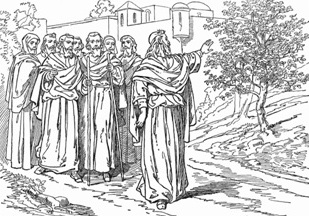
Now learn a parable of the fig tree; When his branch is yet tender, and putteth forth leaves, ye know that summer is nigh:  So likewise ye, when ye shall see all these things, know that it is near, even at the doors.  Mat 24:32-33 KJV

This is the first of five parables in Matthew 24 & 25 and is just a simple illustration of the nearness of Christ’s Second Advent as well as the rapture (7 years earlier), which is the subject of Matthew 24-25. “Now learn a parable [illustration] of the fig tree [Luke adds “and all the trees” 21:29], when his branch is yet tender and putteth forth leaves ye know [what?] that summer is nigh: so likewise ye, when ye shall see all these things [the signs of Christ’s coming of Matthew 24:4-26], know that it [the Second Advent, not the restoration of Israel] is near, even at the doors” Mt. 24:32-33

“This generation shall not pass, till all these things be fulfilled” Mt. 24:34 The last generation living on earth, at the time all these things will be fulfilled.  We do not have to use this parable for the basis of the doctrine of the restoration of Israel, for there are many plain passages that cover that doctrine satisfactorily. Then too, that all of Matthew 24:4-26 is fulfilled in one generation is further evident from this parable of the fig tree, for no tree puts forth leaves throughout the season. This proves that all these things will be fulfilled in one generation only and not in several of them.

Heaven and earth shall pass away, but my words shall not pass away.  In Matthew 24:34-35 we have the infallibility of the above truths stated. Heaven and Earth shall be changed, but these truths shall not be changed. Lk. 16:16; Heb. 1:10-12 The Greek word for “pass away” in this passage means “pass from one state to another” and not “cessation of existence,” as proven in 2 Cor. 5:17c all things are become new and other passages. The Heaven and the Earth will never be annihilated.